October 3, 2019

To find all the natural numbers which gets reverse when multiplied by 9


To find all the natural numbers which gets reverse when multiplied by 9
1089 = 33×33
1089 ×9 = 9801 = 99×99
1089 is the smallest natural number which gets reverse when multiplied by 9.
There is interesting pattern for all the numbers.


1089 × 9 = 9801
10989 ×9 = 98901
109989 × 9 = 989901
1099989×9 = 9899901
10999989×9 = 98999901 
10891089×9 = 98019801
 ..............  
If number of digits in number is not  multiple of 4 then only one number is possible.
10999…(n-4) times 89 ×9 =98999…..(n-4) times 01
 Where n is number of digits.

If number of digits in the number  is multiple of 4 then 1 more number is possible.
10891089 × 9 = 98019801
10891089…….1089 × 9 = 98019801……….9801

September 29, 2019

To find N natural numbers not necessarily distinct such that their sum is equal to their product

To find N natural numbers not necessarily distinct such that their sum is equal to their product


2+2 =2×2
1+2+3=1×2×3
1+1+2=4=1×1×2×4
1+1+1+2+5=1×1×1×2×5
1+1+1+1+2+6=1×1×1×1×2×6

In general,
1+1+1+…..{(N-2) times}+2+N = 1×1×……{(N-2) times}×2×N
 
The above formula was published in Ramanujan Mathematical Society newsletter in June-2014 under problem and solution section.
 

September 17, 2019

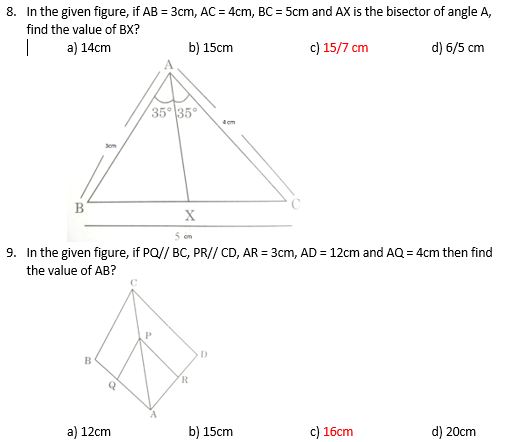
Triangle - MCQ- Class 10 - By Dr Rajesh Kumar Thakur


Area related to Circle - MCQ- Class 10 - by Dr Rajesh Kumar Thakur


Co-ordinate Geometry - MCQ- Class 10 - Dr Rajesh Kumar Thakur


Statistics- MCQ - Class 10 - by Dr Rajesh Kumar Thakur


Surface Area and Volume- MCQ - Class 10 - by Dr Rajesh Kumar Thakur


Trigonometry = MCQ- Class 10 - by Dr Rajesh Kumar Thakur


Circle - MCQ- Class 10 - by Dr Rajesh Kumar Thakur


Linear Equation in Two Variables - Class 10 -MCQ - K Bhanumoorthy


Chapter Linear equations.     Class X, CBSE

1)    The given equation is x +2y = 6, the line meets the X axis at
a)  (6, 0)     b)  (0, 6)   c)   ( 3, 0 )

2)    The equation Y axis is   
a)  Y =0     b)  X =0   , c)    XY = 0

3)    The given equations  x + y = 2  ,  - x + y = 4; intersect at 
a) (3, 1)  b)    ( - 1, 3 )   c ) ( - 1, -3 )

4)    The given equations x + 2 y   = 3  ,   2x + 4 y = 5  are 
a)  Parallel    b)   Not parallel   c )  many  solutions

5)    The given  equations  x + y= 5, 2x + 2y = 5 are
                       a) Inconsistant       b) consistant       c) One solution 

6)    The line  2x + y  - 4 = 0,   meets the Y axis at
                       a) (4, 0)        b) ( 0, 4 )               c  ) ( 2,4)  

7)    The equations  3x + 2y = 2, 6x + 4y = 4 ,have
                        a) No solution   b) one solution c) infinitely many 

8)    The lines , x – 2y -2 = 0,  2x + y – 4 = 0  have
                       a) One solution b) No solution c) many solutions.

9)    The given equation is 2x – y – 2 = 0 , the line meets the Y axis at
                     a) ( - 2, 0 )    b ) ( 2, 0 )   c ( 0 , - 2 ) 

10)              The value of  k,  for which  kx + 3 y -  ( k – 3 ) = 0, and
                        16x  + ( 8 + K )y – k = 0 have infinite solutions
                         a)  2                   b ) 4             c)  8

Answers : 1) a , 2 ) b , 3)  b ,   4 ) a ,  5 ) a ,  6 )  b ,  7)  c ,  8)  a ,  9)  c ,   10 )  b


This MCQ paper is designed by Shri K Bhanumoorthy, a retired KV Prinicipal.

Mr. Bhanumoorthy is a winner of Ramanujan Award and Life time Achievement Award for his service in the field of mathematics. He lives in Banglore.


WORLD PI DAY (14th March 2026) QUIZ

 Dear All On the occasion of  World Pi Day being celebrated on 14th March (3/14 in American Date style) every year since 1988 when it was fi...